
Small Group Wildlife Photography Tours: 5 Myths Debunked


What if the biggest obstacle to your dream wildlife photo isn't the animal's behavior, but the number of people sitting next to you in the vehicle? Many photographers worry that joining small group wildlife photography tours might mean compromising their creative vision or feeling rushed by others. It's a valid concern. We've all felt that sting of missing a rare moment because a crowded truck blocked the view or because the guide was too busy to help with a tricky camera setting.
The good news is that a smaller group is actually your greatest technical advantage. It's the secret to capturing professional-grade images while enjoying a completely stress-free experience. You deserve a journey where you can work at your own pace and receive one-on-one coaching from a seasoned expert. In this article, we'll debunk five common myths about these intimate expeditions. You'll learn how the right group size can transform your portfolio and give you the quiet, focused time you need to master your craft in the wild.
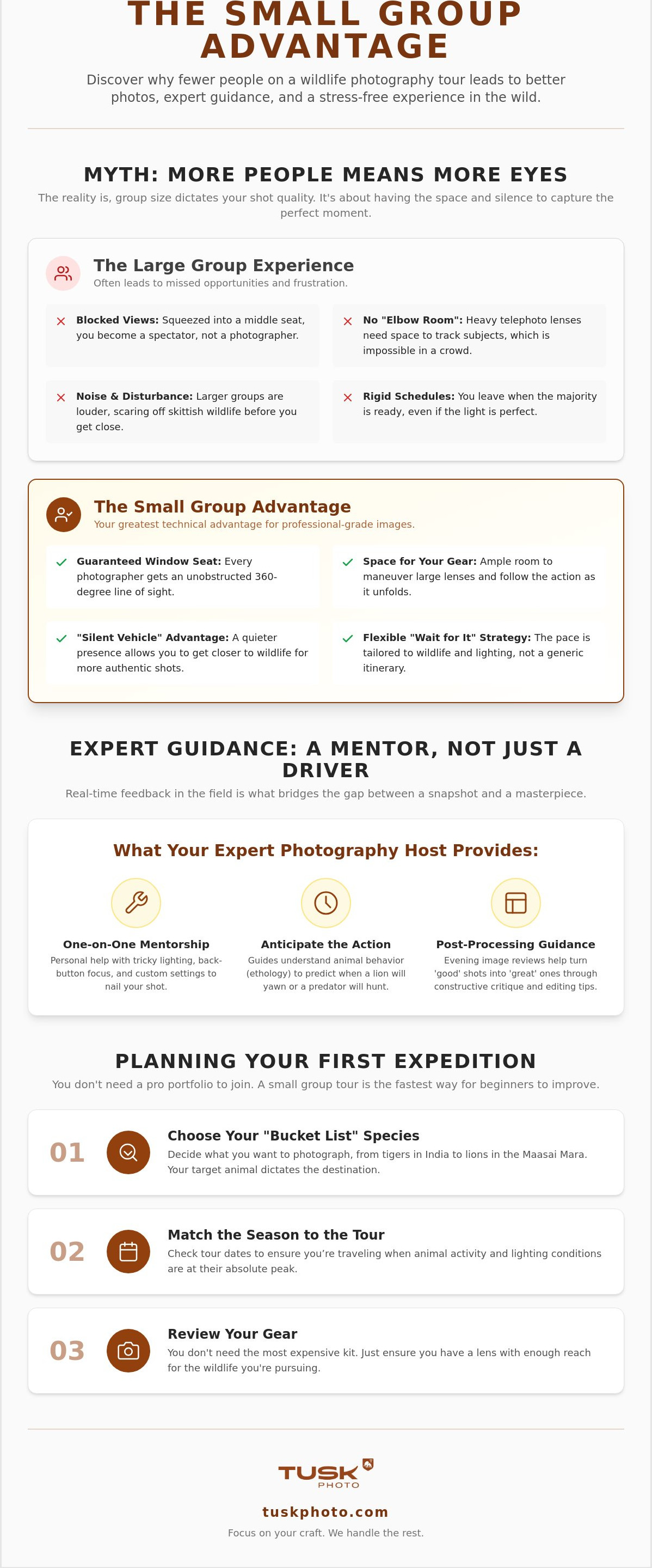
You might think that having twelve people in a vehicle means twelve pairs of eyes searching for a lion. While that sounds helpful, the reality for a photographer is quite different. More people usually means more elbows, more equipment bags, and fewer clear views. When you choose small group wildlife photography tours, you're prioritizing your ability to actually take the shot once the animal is found. It's about quality, not just quantity.
Professional telephoto lenses are heavy and long. They need physical space to swing and track a moving subject. If you're squeezed into a middle seat, you're essentially a spectator. We prioritize the "window seat" rule, ensuring every guest has an unobstructed line of sight. In high-end photography settings, this often means limiting the vehicle to just three or four guests. This gives you the "elbow room" needed to handle large gear without bumping into your neighbor.
There is also a huge "silent vehicle" advantage. Animals are incredibly sensitive to sound and movement. A vehicle with only a few people is naturally quieter and less intimidating than a large, noisy group. This lower profile allows you to get closer to skittish subjects without disturbing their natural behavior, leading to more authentic images for your portfolio.
When a leopard drops from a tree or a cheetah starts a sprint, it rarely happens in the direction you're already facing. You need a 360-degree view to react. In a small group, your guide can quickly reposition the vehicle so everyone has the perfect light and angle. You aren't fighting for a tiny gap between someone else's shoulder and the roof frame. You have the freedom to move and follow the action as it unfolds.
Large groups often operate on a rigid schedule. If the majority of the group wants to head back for a meal, you're leaving, even if the light is just getting perfect. Smaller groups, like those on Tusk Photo scheduled tours, have the patience to wait. If a mother bear is about to wake her cubs, we stay. We tailor the pace to the wildlife and the lighting, ensuring you aren't rushed by a generic itinerary.
You can watch a hundred tutorials on how to capture a bird in flight, but those videos can't see the lighting conditions you're facing right now. There's a common belief that technical skills can be mastered alone through online videos. In reality, real-time feedback from a professional is what actually bridges the gap between a snapshot and a masterpiece. When you join small group wildlife photography tours, you're investing in a mentorship that happens in the moment, not just a ride to the park.
Your expert photography host acts as a second set of eyes. They don't just find the animals; they understand ethology, which is the study of animal behavior. This knowledge allows them to predict when a lion might yawn or when a predator is about to hunt. By anticipating these movements, they position you for success before the action even starts. It's about being proactive rather than reactive, ensuring you're ready for the shot before it happens.
These tours also foster a unique sense of community. Instead of competing for space, you're part of a "tribe" of like-minded creators. You'll find that sharing tips and celebrating each other's wins makes the experience far more rewarding than a solo trip. It's a supportive environment where everyone wants to see everyone else succeed.
Imagine you're struggling with exposure compensation because of a bright sky behind a dark forest canopy. This just means you're trying to balance the light so your subject isn't too dark. In a large group, you might be left to guess. In a smaller setting, your host can spend fifteen minutes right by your side. They can help you set up back-button focus, which is a professional way to keep moving animals sharp, or tweak your settings to handle that tricky light. This personal attention ensures you leave with the shots you came for.
The learning doesn't stop when the sun goes down. Many of our scheduled tours include evening image review sessions. This is where the real growth happens. You'll sit down with your mentor to look at the day's work and receive constructive, friendly critique. Learning how to turn a "good" shot into a "great" one through better framing or editing is a skill you'll take home and use forever. It's the perfect way to polish your portfolio while relaxing after a day in the field.
Many people think you need a professional portfolio before you can even consider booking a specialized trip. This is one of the biggest misconceptions in the industry. In fact, small group wildlife photography tours are often the fastest way for beginners to improve. You're surrounded by experts and peers who help you skip the years of trial and error that come with self-guided travel. You get to focus entirely on your craft while the logistics are handled for you.
To start planning your journey, focus on these three simple steps:
Decide whether you want to track tigers in India or watch lions in the Maasai Mara. Your target animal dictates the destination and the style of shooting you'll do.
Check the upcoming tour dates to ensure you're traveling when the lighting and animal activity are at their peak.
Don't worry if you don't have the most expensive kit. Most expeditions are friendly to various equipment levels, though you'll want to ensure you have a lens with enough reach for the subjects you're chasing.
You also need to decide on the format of your trip. A Scheduled Tour is perfect for solo travelers or those who want a tried-and-tested itinerary. If you have a specific creative vision or want to travel with a private group, a custom journey might be the better fit for your goals.
Be careful when booking your trip. There is a massive difference between a "photo-friendly" tour and one that is "photographer-led." A real expedition includes specialized equipment like beanbags or gimbal mounts in the vehicles to steady your long lenses. More importantly, the entire day is built around the light, not just getting to a hotel by a certain time.
Success in the field requires a specific mindset. You need to be camera-ready at all times because nature doesn't wait for you to find your settings. Beyond the technical side, embrace the community. One of the best parts of small group wildlife photography tours is the shared excitement when someone captures a rare moment. It's about learning together and celebrating the beauty of the natural world.
Capturing that one unforgettable image requires more than just a good camera. It takes the right environment and the right support. Choosing small group wildlife photography tours is the most effective way to solve the common frustrations of the field. By limiting the number of guests, you secure the personal space needed for long lenses and the clear lines of sight essential for fast-moving subjects. You also gain a mentor who helps you master tricky light and complex settings in real time.
Whether you're a beginner looking to improve or a seasoned pro seeking exclusive access, these intimate journeys are designed for your success. Our expeditions are led by professional photography hosts who know these world-class destinations inside and out. They ensure you aren't just a passenger, but an active creator with every opportunity to succeed. It's time to stop worrying about the crowds and start focusing on the art of the shot.
For travellers who appreciate this level of curation but prefer the energy of the arena, Ultimate Sporting Experience specialises in luxury sports travel to major events worldwide.
While these tours focus on the wild, if you're looking for professional photography closer to home for school or sports events, you can click here to see how experts capture those special moments.
Explore our upcoming Small Group Wildlife Photography Tours and join a community of passionate creators. Your next great adventure is waiting, and we can't wait to help you see it through your lens.
Yes, investing in a smaller group is absolutely worth it for the technical advantages and the growth of your skills. You aren't just paying for a seat; you're paying for the "elbow room" needed for long lenses and the one-on-one time with a professional host. These factors significantly increase your chances of capturing world-class images that a standard, crowded tour simply can't provide.
A professional expedition typically limits group sizes to ensure every photographer has a window seat. For most small group wildlife photography tours, this means having only three or four guests in a vehicle that might normally hold ten. This specific number ensures you have 360-degree views and enough space to move your equipment without bumping into others as the action unfolds.
You don't need the most expensive professional gear to join us. We welcome photographers at all skill levels, whether you're using a high-end mirrorless setup or a more basic entry-level kit. The focus of the tour is on improving your technique and understanding light and composition. Our expert hosts are there to help you get the best possible results from whatever equipment you currently own.
Solo travelers are a huge part of our community. Many people join our small group wildlife photography tours on their own because it's a safe and easy way to meet like-minded creators. You'll quickly find yourself part of a supportive group that shares your passion for nature. It's a great way to enjoy a specialized adventure without the stress of planning a solo expedition from scratch.


