
Photographing Amboseli: The Land of Tuskers
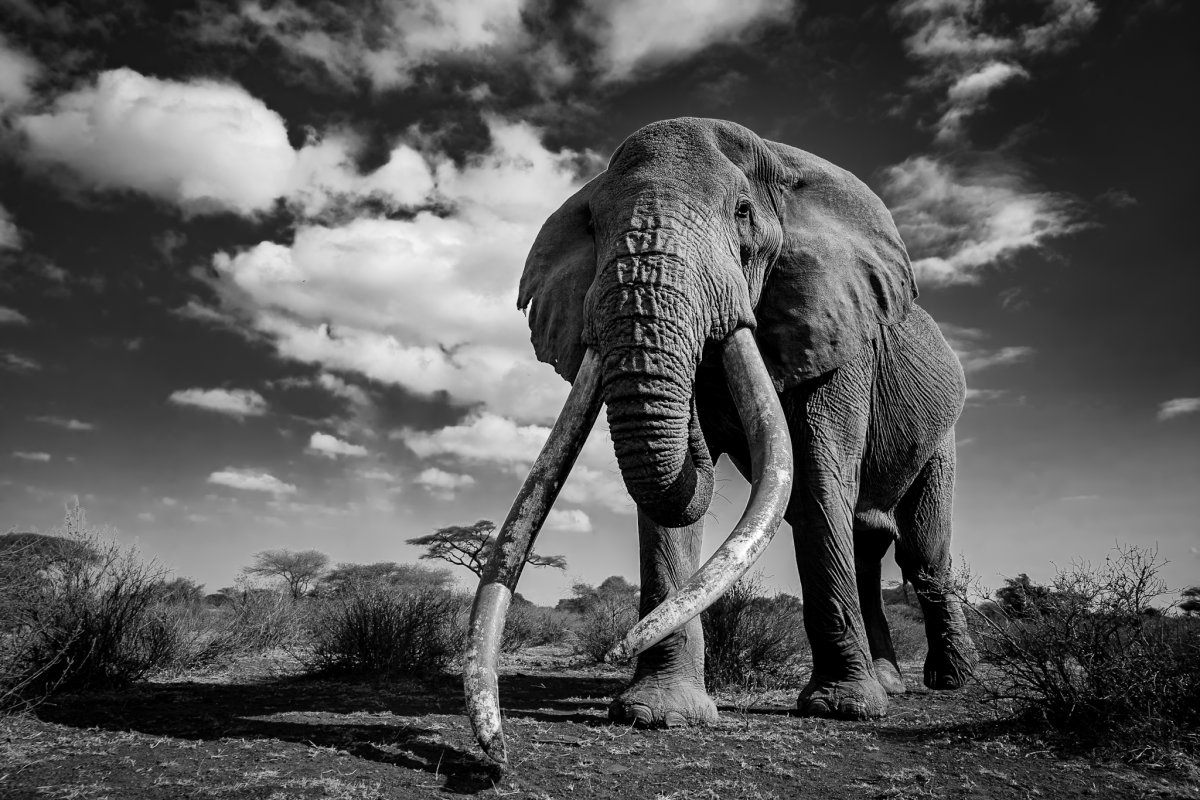

A massive pair of tusks doesn’t automatically make an elephant a super tusker. Each tusk must weigh more than 100 pounds to meet that distinction; “big tusker” is a broader description for a bull with notably large tusks. In Amboseli, the land of tuskers, that difference gives every sighting added meaning.
It’s easy to see why Amboseli’s elephants draw photographers: their presence is striking, and their family life is just as compelling. This guide explains how elephant families live, what sets super tuskers apart, and how to time a visit for wildlife encounters and views of Kilimanjaro. You’ll also learn how changing conditions shape the landscape and visibility, so you can plan for more than a single memorable photograph.
About 2,000 elephants use the wider Amboseli ecosystem; approximately 1,600 live in the national park. Females and calves travel in family groups, guided by experienced matriarchs. These bonds shape daily movement, feeding, and care for young elephants. The Amboseli Elephant Research Project has tracked elephant families since 1972, building long-term knowledge of individuals and their relationships.
Birth years help researchers and guides identify familiar bulls. Vronsky was born in December 1976, Pascal in January 1980, and Tee Jay in 1988. Michael was born in May 1991, while Esau was born in 1990. Recognizing an elephant involves more than age: tusk shape, ear markings, and body features help distinguish individuals. The ecosystem has around ten confirmed super tuskers.
Elephant deaths also form part of Amboseli’s record. Tim died of natural causes in February 2020. Gilgil, aged 35, was killed by trophy hunters in September 2023. Craig died at 03:32 AM on 4 January 2026, and One Ton was found dead on 5 July 2026. One Ton was known among the Maasai as Mpole, meaning “the gentle one.”
Amboseli’s defining draw is the chance to observe elephant families and large-tusked bulls in a striking landscape. It also offers varied birdlife: according to Kenya Wildlife Service, the park is one of Kenya’s 60 Important Bird Areas and hosts over 400 bird species, including 40 birds of prey.
Amboseli National Park is in southern Kenya, near the Tanzania border. From Nairobi, the drive via Namanga takes 4 to 5 hours; a flight from Wilson Airport takes about 45 minutes.
For 2026, the entrance fee is about USD 90 per non-resident adult per day. Accommodation is available in and around the park; costs depend on location, season, room type, and included services.
Compared with other Kenyan safari parks, Amboseli is especially known for its elephants, family groups, and views of Kilimanjaro. That combination has earned it the name “the land of tuskers.”
A big tusker is a bull elephant with notably large tusks. The term describes appearance, but it doesn’t set a precise weight threshold. “Super tusker” is more specific: each tusk must weigh more than 100 pounds. Both tusks must meet the test; a combined weight above 100 pounds isn’t enough.
That distinction matters in Amboseli, where an impressive-looking bull may not qualify as a super tusker. Tusk length alone doesn’t determine the category. The defining measure is the weight of each tusk, so a long, slender tusk and a shorter, heavier one may not match expectations based on appearance alone.
The 100-pound mark refers to each individual tusk, not the pair together. It’s an ivory-size threshold used to distinguish an exceptionally large-tusked bull. The category is rare: fewer than a few dozen super tuskers remain across Africa, and Kenya is estimated to have 15 to 20 in 2026.
Gilgil offers a clear example of the threshold. His tusks exceeded 100 pounds, placing him among the super tuskers. Compare that measurable standard with the broader label “big tusker,” which can describe a bull whose tusks look substantial without meeting the super-tusker test.
For photographers, the distinction adds context to a sighting, but it shouldn’t replace attention to the whole animal. Frame the tusks alongside the bull’s face and surroundings. A photograph can show their shape and scale, while the 100-pound criterion explains why a confirmed super tusker holds a distinct place in Amboseli’s elephant story.
Vronsky was confirmed as a super tusker in 2024 by Big Life Foundation, illustrating that the label is tied to the tusk-weight criterion rather than simply an impressive sighting. For observers, that confirmation helps distinguish a documented classification from a visual impression, while the broader term big tusker remains useful for describing elephants with notably large tusks.
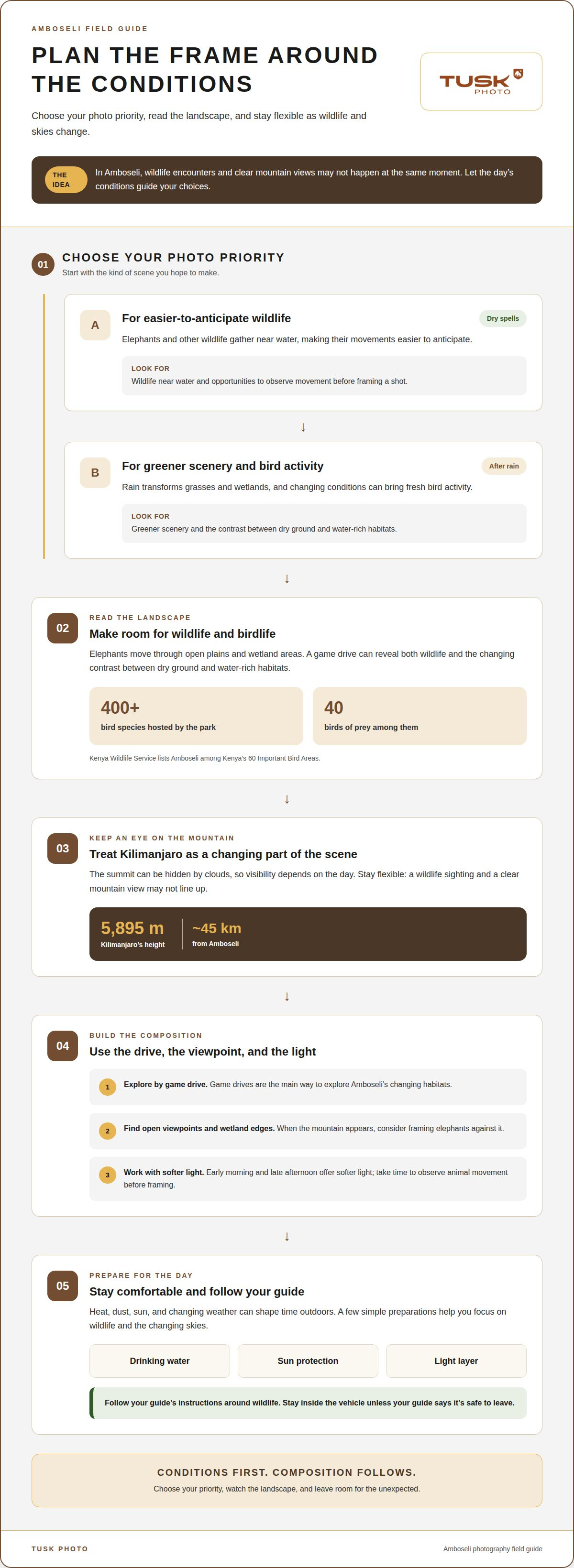
The best season in Amboseli depends on the photographs you want to make. During dry spells, elephants and other wildlife gather near water, making their movements easier to anticipate. After rain, grasses and wetlands transform the landscape, and changing conditions can bring fresh bird activity. Choose the season to suit your priority: clearer wildlife encounters or greener scenery.
Across the ecosystem, elephants move through open plains and wetland areas, while birdlife adds variety to the frame. Kenya Wildlife Service lists Amboseli among Kenya’s 60 Important Bird Areas, with over 400 bird species, including 40 birds of prey. A game drive can reveal both wildlife and the contrast between dry ground and water-rich habitats.
Mount Kilimanjaro rises to 5,895 metres, about 45 kilometres from Amboseli. Clouds can obscure its summit, so the mountain’s visibility depends on conditions on the day. Build flexibility into your plans: wildlife sightings and clear mountain views don’t always happen at the same moment. A quiet pause at an open viewpoint can create a strong landscape composition.
Game drives are the main way to explore Amboseli’s changing habitats. Look for open viewpoints and wetland edges, then compose elephants against the distant mountain when it appears. For photography, use the softer light of early morning or late afternoon, and take time to observe animal movement before framing a shot.
Heat, dust, sun, and changing weather can shape a day outdoors. Carry drinking water, sun protection, and a light layer for shifting conditions. Follow your guide’s instructions around wildlife, and remain inside the vehicle unless your guide says it’s safe to leave. These simple steps let you focus on Amboseli’s wildlife and changing skies.
Tusk Photo helps photographers turn an interest in wildlife into a thoughtfully planned journey. Its Scheduled Photo Safaris offer a structured way to explore photographic destinations with experienced guides, whether you’re building confidence or refining an established practice.
If you want a journey shaped around particular wildlife or photographic priorities, Custom Tours provide a more personal route. On-Demand Tours offer another way to plan an expedition. The right format depends on how closely you want the itinerary tailored to your interests and travel plans.
For an Amboseli-inspired photography trip, consider which matters most: a scheduled departure or a journey designed around your priorities. Explore Tusk Photo’s scheduled tour dates, or visit Tusk Photo to discuss your plans.
A strong wildlife photograph begins before you raise the camera. Decide what you want to notice: the quiet connection within an elephant family, the shape of a bull’s tusks, or the scale of the surrounding landscape. Then leave room for the unexpected. In Amboseli, the land of tuskers, patience can turn a planned image into a more personal encounter.
Your travel plans can support that approach. Think about the moments you hope to photograph and the pace that lets you observe them with care. Tusk Photo’s Scheduled Photo Safaris offer set departures, while Custom Tours can shape the journey around your photographic interests.
Share your Amboseli photography plans with Tusk Photo, and take the next step toward seeing the landscape through your own lens.
Choose a dry spell if you want to focus on wildlife encounters, or a period after rain for greener scenery and bird activity. The best fit depends on your photography priorities. For a flexible itinerary, leave time to revisit an area as light and animal movement change during the day, rather than planning every photograph around a single drive.
Amboseli National Park gates are open from 6am to 6pm in 2026. Plan your entry, wildlife viewing, and exit within those hours. Follow instructions from park staff and your guide, and keep your vehicle in designated areas during wildlife viewing. Allow time for the return to the gate, especially if your route crosses different parts of the park.
Look for an open viewpoint with a clear line toward Mount Kilimanjaro, and keep your schedule flexible because clouds can cover the summit. Pause to assess the sky during your drive, then frame the mountain with foreground details such as plains or wildlife. This creates a stronger sense of scale than photographing the peak alone.


