
Pantanal Bird Photography Tour: Capturing the Colors of the World's Largest Wetland


In the Pantanal, the birds don't hide in the canopy; they perform in the open, making it the world's most productive classroom for bird photography. You've probably felt the frustration of trekking through thick brush only to have a rare species vanish before you can even click the shutter. It's also normal to worry about your camera gear in the humidity or missing out on the brilliant blue of a Hyacinth Macaw. A professional Pantanal bird photography tour is designed to take those stresses away and put you exactly where the action is.
We want to help you bring home a diverse portfolio of colorful, sharp images. Discover how to capture stunning images of over 450 bird species in the Pantanal with our expert-led photography guide. We will show you how to master difficult flight shots and help you decide whether a scheduled or tailor made tour is the best way for you to experience this wetland paradise.
The Jabiru Stork is the iconic symbol of the wetlands. These massive birds stand five feet tall and look almost prehistoric with their white feathers and bright red neck bands. Next is the Hyacinth Macaw. Their cobalt blue feathers are a dream to capture, especially when they gather in the palm trees. For those who love action, the riverbanks are home to five species of Kingfishers and various Raptors. Watching a Snail Kite dive for a meal provides the perfect opportunity to practice your high-speed flight photography.
While the Amazon has incredible biodiversity, the Pantanal wins for visibility. In the rainforest, birds often stay hidden high in the thick leaves. In the Pantanal, the low vegetation and open floodplains mean your subjects are easy to spot and track. Accessibility is another huge plus. We use stable boats and specialized vehicles to get you incredibly close to the wildlife. This allows for intimate portraits without disturbing the animals. Whether you choose one of our Scheduled Tours or prefer a Tailor Made Tour, the ease of seeing these birds makes a Pantanal bird photography tour the superior choice for building a professional portfolio.
Packing for a Pantanal bird photography tour is all about finding a balance between reach and speed. You'll want a lens that can handle a variety of distances. A versatile 100-400mm or 200-600mm lens is usually the best tool for the job. These lenses allow you to quickly switch from a wide shot of a Jabiru nest to a tight portrait of a colorful toucan. Stability is key. Since much of our time is spent on the water, a tripod is often too clunky for a boat. We recommend using a beanbag or a gimbal head instead. These tools let you rest your gear on the boat's edge, giving you the support you need for those heavy telephoto lenses.
Freezing the action of a bird in flight requires the right settings. To capture the fast wings of a kingfisher, you should aim for a shutter speed of at least 1/2000th of a second. In 2026, many mirrorless cameras feature "Animal Eye AF." This tracks the bird's eye automatically, even during erratic movement. It lets you focus on composition while the camera handles the focus. For more advice on getting sharp results, check out our wildlife photography tips for beginners for more on sharp imaging.
Planning your Pantanal bird photography tour means preparing for both dust and water. During the dry season, the Transpantaneira highway becomes very dusty. This dust can find its way into your camera sensor if you aren't careful. Try to avoid changing lenses outside and keep a cleaning kit handy. On the river, humidity is the bigger challenge. A simple rain cover protects your gear from moisture and splashes, even on sunny days. If you want to see when we head out to these locations, browse our Scheduled Tours to find a date that works for you.
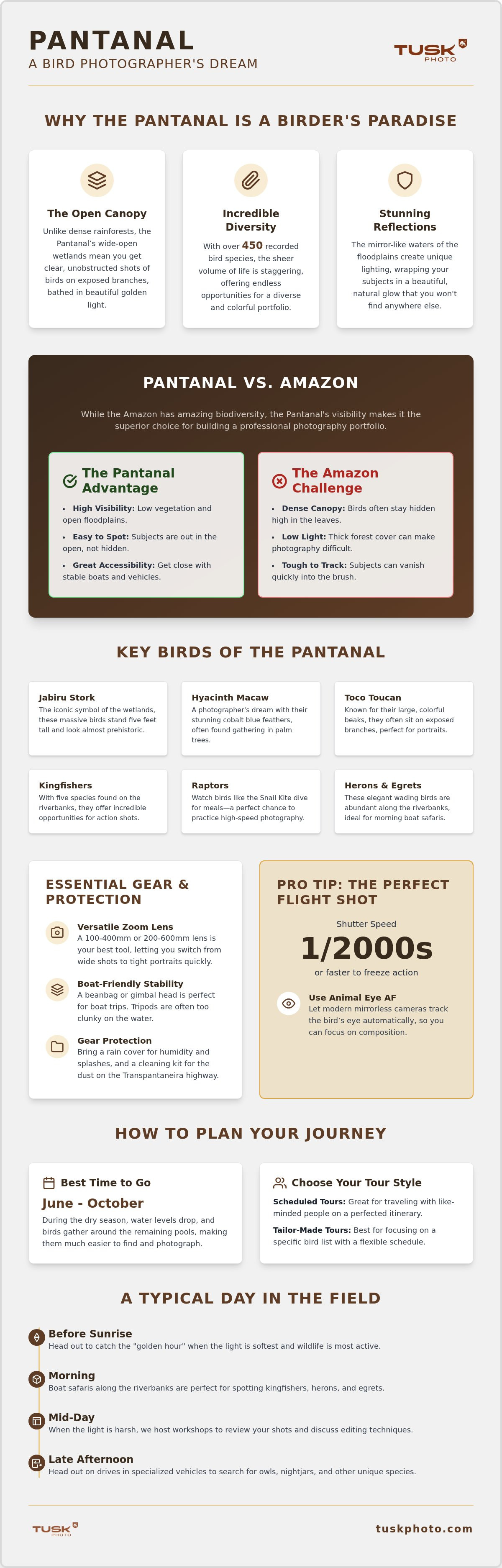
Choosing the right time for your Pantanal bird photography tour is the first step to a successful trip. While the wetlands are beautiful year-round, the dry season from June to October is the golden window for birders. As the water levels drop, birds gather around the remaining pools. This makes them much easier to find and photograph than during the rainy months. You'll stay in lodges that offer a great balance of comfort and proximity to nature. We make sure you're close enough to the wildlife to catch the best light without having to travel for hours each morning.
Joining a scheduled departure photography tour is a great way to travel with like-minded people. These trips follow a set itinerary that we've perfected over many years. However, if you have a specific list of birds you want to find, you might prefer a tailor-made photography safari. This gives you the freedom to set your own schedule for your Pantanal bird photography tour and focus on the species that matter most to your portfolio.
A typical day starts before sunrise to catch the "golden hour" when the light is softest. Morning boat safaris are perfect for spotting kingfishers and herons along the riverbanks. During the brighter mid-day hours, we often host small workshops to review your shots and discuss editing techniques. In the late afternoon, we head out on drives to search for owls and nightjars. Having an expert guide who knows exactly where the birds will be makes a huge difference in the quality of your images.
The Pantanal is a place where every river bend offers a new chance for a world-class photo. We've explored why the open landscape is a dream for visibility and how the right gear helps you freeze the action of a kingfisher in mid-air. Whether you're chasing the vibrant blue of a Hyacinth Macaw or practicing your flight photography, a Pantanal bird photography tour provides the high-access encounters you need to build a professional portfolio.
Our trips feature expert photography hosts who understand bird behavior as well as they know their cameras. We keep our group sizes small to give you maximum shooting space, and our hand-picked lodges offer the best possible wildlife access. It's time to turn your dream of photographing the world's largest wetland into a reality. View our upcoming Pantanal photography tour dates and join us in the field. Your next great wildlife image is waiting for you.
To further enrich your journey and understand the cultural heritage of the regions you explore, learn more about Tribu Spirit and how their support for indigenous wisdom creates a positive impact.
The best time for a Pantanal bird photography tour is during the dry season, which usually runs from May to October. As the floodwaters recede, birds gather in high numbers around the remaining water sources. This makes it much easier to find and photograph them compared to the rainy months. You'll also enjoy clearer skies and more predictable light, which are essential for capturing those vibrant, high-quality images.
You don't necessarily need a massive prime lens to get great shots. While a 600mm lens is helpful, many photographers find that a versatile zoom like a 100-400mm or 200-600mm works perfectly. These lenses are lighter and much easier to handle on boats. Since the birds in this region are often quite approachable, you'll find that these zoom ranges provide plenty of reach for stunning portraits and action shots.
Yes, the Pantanal is generally very safe for travelers and photographers. We stay at established lodges and use experienced local guides who know the terrain and the wildlife well. While you're in a wild environment, following your guide's instructions ensures you stay at a safe distance from the animals. We also take care of all the logistics, so you can focus entirely on your photography without any stress.
While our focus is on feathered subjects, there's a very high chance you'll see Jaguars during your Pantanal bird photography tour. This region has a massive population of these cats, with about 8 individuals per 100 square kilometers. Since we spend plenty of time on the river looking for herons and kingfishers, we often encounter jaguars hunting or resting along the banks. It's a fantastic bonus for any wildlife portfolio.


