
Kenya Photography Safari: The Best Spots and Times for Your 2026 Portfolio


The best wildlife photograph in Kenya often depends less on your camera than on where you are, when you arrive, and how your vehicle is positioned. A Kenya photography safari takes planning, especially if you hope to see the Great Migration or capture a sharp image of a lion or leopard in dusty conditions.
Which parks offer the best light, and when should you go? The Maasai Mara’s migration window is generally July to September, but wildlife and weather do not follow a fixed schedule. This guide compares Kenya’s top photography locations, explains how to plan around seasonal conditions, and covers practical ways to prepare for shooting in the field. You’ll also find guidance on choosing a photography-focused tour, whether you’re new to wildlife photography or refining your portfolio.
Choose locations according to the images you want to make. The Maasai Mara is known for predators and migration action, Amboseli for elephants beneath Kilimanjaro, and Samburu for distinctive northern wildlife. Lakes Nakuru and Naivasha offer birdlife and a different pace for a Kenya photography safari.
The Mara’s open plains give you space to frame lions against the grass and follow movement without a dense backdrop. In the soft light around sunrise and sunset, start with a lower ISO, which controls how sensitive the camera is to light. Raise it as the light fades or the animal moves faster. A guide with wildlife photography experience can help you look for a clear view and, where the terrain allows, a lower shooting angle. When comparing tours, ask how much time is set aside for photography in the field and how guides support participants as scenes unfold.
Tusk Photo offers scheduled photography tours, as well as tailor-made photography tours for photographers with specific preferences. Experienced guides provide photographic opportunities in the field, with guidance suited to beginners and more experienced photographers.
Look for elephants, including large-tusked individuals, with Mount Kilimanjaro as a backdrop when conditions allow. Leave space around the animal to show the scale of the landscape.
Photograph distinctive northern species such as the reticulated giraffe and Grevy’s zebra. Their markings and shapes bring variety to a portfolio of Kenya’s wildlife.
Bring a longer lens for birds at the water’s edge. Flamingo colour and numbers can vary, so treat a vivid pink shoreline as a possibility, not a guarantee. At either lake, look for clean backgrounds and reflections to make bird portraits stand out.
Choose your travel dates based on the scenes you want to photograph. July to September is the peak window for the Great Migration in the Maasai Mara, when wildebeest and zebras move through the reserve and river crossings may offer dramatic action. Crossings are unpredictable, so allow time in the Mara and follow your guide’s advice about where to wait and how to find a clear view. Exact timing in 2026 can vary with rainfall.
From June to October, drier conditions can make wildlife easier to spot around water, but dust may reduce visibility and settle on camera gear. The rainy months bring greener landscapes, dramatic skies, and opportunities for images that combine wildlife and scenery. January and February are a short dry season, with clear light, green surroundings, and young animals that can add intimate moments to your portfolio.
Keep a lens cover on between sightings, have a cleaning kit close at hand, and change lenses as little as possible in dusty conditions.
Protect your camera from rain and look for birds, fresh colours, and animals framed by storm-lit skies.
January and February can also bring calving-season scenes. Young animals and the predators that hunt them create the possibility of fast-moving, emotionally powerful images. Keep a respectful distance and be ready to adjust your settings as the action changes.
For a 2026 Kenya photography safari, choose a season that suits your priorities and check tour dates before making travel arrangements. A guide with photography experience can help you respond to changing light and look for useful shooting positions. Visit the scheduled photography tour dates to see whether a departure fits your plans. If you have a particular species, region, or pace in mind, consider asking about a tailor-made journey.
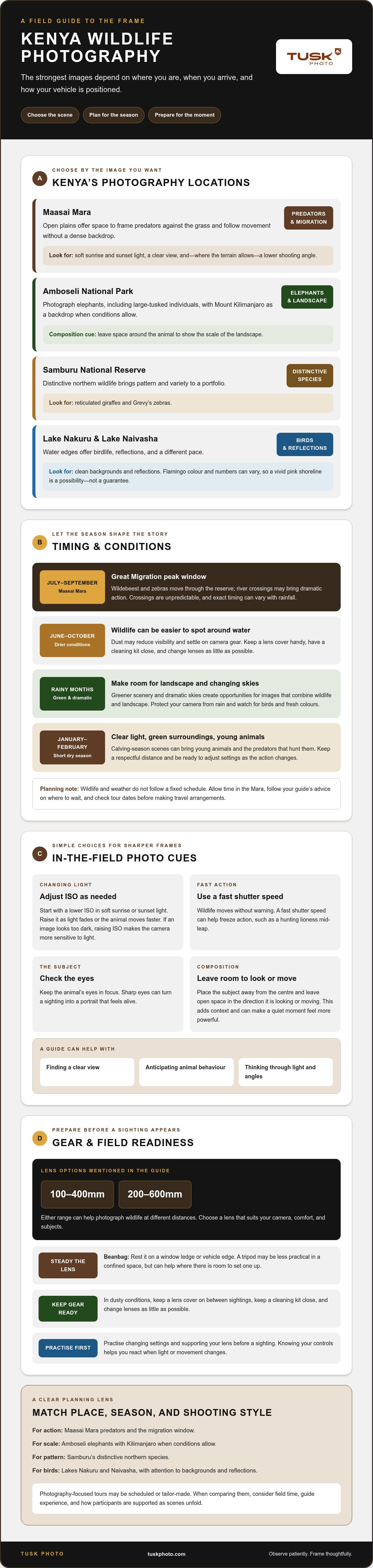
Wildlife moves without warning. To freeze a hunting lioness mid-leap, use a fast shutter speed, which means the camera takes the picture in less time. If the image looks too dark, raise the ISO, a setting that makes the camera more sensitive to light. Check that the animal’s eyes are in focus. Sharp eyes can turn a simple record of a sighting into a portrait that feels alive.
Give the animal room in the frame. The rule of thirds means placing your subject away from the centre, as if the picture were divided into a simple grid. Leave open space in the direction the animal is looking or moving. This adds context and can make a quiet moment feel more powerful. For more ideas, explore negative space in photography. A guide can also help you anticipate animal behaviour and consider different angles. A photography tour with an expert guide gives you opportunities to practise in the field.
A 100-400mm or 200-600mm lens can help you photograph wildlife at different distances, from a nearby elephant to a more distant leopard. Choose a lens that suits your camera, comfort, and subjects, and be ready to adjust as the scene changes. In a safari vehicle, a beanbag can rest on a window ledge or vehicle edge to steady your lens. A tripod may be less practical in a confined space, but can help where there’s room to set one up.
On a Kenya photography safari, practise changing settings and supporting your lens before a sighting appears. Knowing where your controls are helps you react when the light or movement changes, and a steady lens can help you capture sharp detail, clear eye contact, and a strong sense of place.
Your chosen location and season shape the story your portfolio tells, from Mara predators in action to elephants framed by Kilimanjaro. Sharp wildlife images also depend on preparation, steady support, and being ready to respond as a scene unfolds.
A Kenya photography safari with experienced guides gives you opportunities to practise in the field and get help thinking through light and composition. Before booking, compare the locations and dates with the subjects you most want to photograph. If a scheduled departure does not match your preferred region or pace, a tailor-made journey may be a better fit.
Explore Tusk Photo’s scheduled tour dates and choose a departure that suits your photography plans.
July to September is the strongest window if your main goal is to photograph the Great Migration in the Maasai Mara, though river crossings can’t be scheduled. January and February are alternatives for clear light, green scenery, and young animals. The best month for your Kenya photography safari depends on the images you want, and migration timing can shift with rainfall.
No, you don’t need a professional camera to enjoy a wildlife photography tour. Use the camera you have and practise focusing and adjusting how bright or dark your pictures look before your trip. A camera with a zoom lens can help you frame animals at different distances, but skill and patience matter too. Experienced photography guides can offer practical guidance in the field, including to beginners.
Solo travel requires planning, and safety can depend on your route, timing, and current conditions. Check your government’s latest travel advice and discuss transport, accommodation, and field arrangements with your tour provider before booking. A guided photography trip can provide structure and guidance during wildlife viewing, but it’s still important to follow local advice and keep personal belongings secure.
There isn’t one right storage amount for a 10-day safari. Estimate it by multiplying your camera’s average file size by the number of photos you expect to take, then allow extra space for video and unexpected sightings. Bring more than one memory card and, if possible, a separate backup drive. Copy files regularly so one lost or damaged card doesn’t hold every image.


